
5 Ways to Find Amazon Online Arbitrage Leads
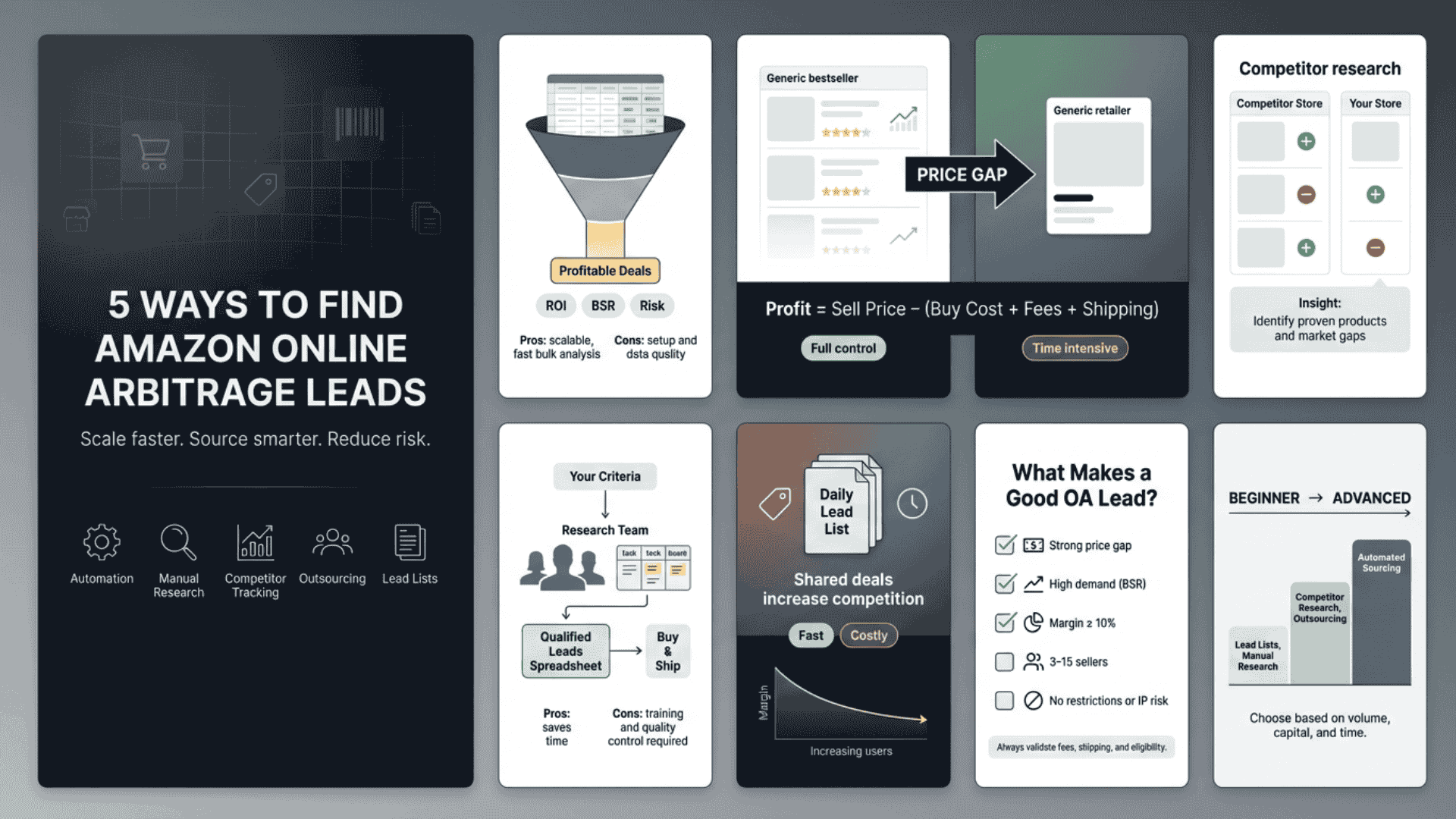
5 Ways to Find Amazon Online Arbitrage Leads
Finding profitable online arbitrage (OA) deals is widely known as one of the most time-consuming parts of selling on Amazon. No matter which sourcing method you use, identifying consistently high-margin products requires effort, discipline, and the right strategy.
If you are serious about scaling your Amazon business and generating sustainable profits, you need to diversify how you source leads. Relying on a single method limits growth and increases risk.
By adopting new lead sourcing strategies, you can streamline your workflow, reduce manual research, and focus on products with real profit potential.
This guide explains five proven methods to find Amazon online arbitrage leads, outlines their pros and cons, and helps you determine which approach best fits your business model.
What Are Amazon Online Arbitrage Leads?
Amazon online arbitrage leads (also called OA deals) are product opportunities where sellers purchase items from online retailers at a lower price and resell them on Amazon for a profit.
These leads can be sourced:
- Manually through product research
- Through automated product scanning
- Via competitor analysis
- By purchasing curated lead lists
- By outsourcing sourcing to researchers or virtual assistants
How Online Arbitrage Works
Sourcing products
Online arbitrage sellers identify products priced below their Amazon Buy Box value. These products often come from:
- Online retail stores
- Discount platforms
- Clearance or seasonal sales
Reselling on Amazon
Once purchased, products are sent to Amazon (usually via FBA) and sold at a higher price. Profit comes from the difference between purchase cost and selling price, minus Amazon fees and expenses.
Key Criteria of a Good Online Arbitrage Lead
Price gap
A meaningful difference must exist between the supplier price and the Amazon selling price. The larger the gap, the higher the profit potential after fees.
High demand
Demand is measured using Amazon Best Sellers Rank (BSR).
- A BSR between 1 and 50,000 generally indicates healthy sales velocity.
Healthy profit margins
After accounting for Amazon fees, shipping, prep, and taxes, the product should deliver:
- At least 10% profit margin (preferably higher for scalability)
Moderate competition
Ideal competition:
- 3–15 sellers on the listing
- Avoid:
- Listings dominated by Amazon itself
- Listings with excessive sellers, which reduce pricing power
No compliance risks
Ensure:
- You are eligible to sell the product
- The item is not restricted
- There are no IP complaints or brand enforcement risks
Failure to check compliance can result in listing removal or account issues.
How to Find Online Arbitrage Leads
Your sourcing strategy should depend on how many products you aim to sell.
- Beginners: manual sourcing or buying ready-to-sell leads
- Advanced sellers: automated sourcing, competitor analysis, or outsourcing
Below are five effective sourcing strategies.
Strategy 1. Automated Sourcing
Automated sourcing (also known as supplier-to-Amazon sourcing) involves scanning supplier price lists or websites and matching those products against Amazon listings to identify profitable opportunities.
How it works
- Product data is extracted from supplier websites
- Hundreds or thousands of SKUs are analyzed
- Filters are applied to identify profitable, low-risk products
Automation reduces human error and enables large-scale sourcing.
Pros
- Scales quickly
- Processes large product lists efficiently
- Data-driven decisions
Cons
- Initial setup and learning curve
- Dependent on supplier data accuracy
Strategy 2. Self-Sourcing (Manual Research)
Self-sourcing means identifying high-demand products on Amazon first, then searching for those same products on other online retailers at lower prices.
How it works
- Research Amazon best-selling and trending products
- Analyze demand, competition, and pricing
- Search external retailers for price discrepancies
Pros
- No subscription or sourcing fees
- Full control over product selection
- Deep understanding of your inventory
Cons
- Time-intensive
- Requires experience to consistently find profitable leads
Strategy 3. Competitor Research
Competitor research focuses on analyzing what other successful Amazon sellers are selling to uncover new product opportunities.
How it works
- Monitor competitor storefronts
- Identify products they add or remove
- Detect brands and categories performing well
Pros
- Reveals proven products
- Reduces guesswork
- Helps spot market gaps
Cons
- Risk of copying instead of innovating
- Requires systematic tracking
Strategy 4. Outsourcing Product Research
Some sellers hire virtual assistants or deal researchers to source leads for them.
How it works
- You define sourcing criteria
- Researchers scan retailers and Amazon
- Leads are delivered in spreadsheets
Pros
- Saves time
- Allows focus on scaling and logistics
Cons
- Quality depends on researcher skill
- Requires training and oversight
Strategy 5. Buying Lead Lists
Lead list services provide pre-researched arbitrage deals via subscription.
How it works
- You pay a recurring fee
- Receive daily or weekly deal lists
- Each lead includes cost, price, fees, and estimated profit
Pros
- Extremely time-efficient
- Beginner-friendly
- Fast inventory sourcing
Cons
- Expensive over time
- Same deals shared with multiple sellers
- Increased competition reduces margins
FAQ
Is online arbitrage legal?
Yes. Online arbitrage is legal as long as you comply with Amazon’s policies and applicable laws.
How profitable is online arbitrage?
Margins typically range from 10% to 50%+, depending on sourcing efficiency and competition.
Is online arbitrage risky?
Yes. Risks include:
- Price drops
- Increased competition
- IP complaints
- Listing restrictions
Proper due diligence minimizes these risks.
How much capital is needed to start?
You can start with $500–$1,000, though higher capital improves scalability.
Is retail arbitrage allowed on Amazon?
Yes, provided the products are authentic, unrestricted, and policy-compliant.
Final Thoughts
Finding profitable online arbitrage leads has never been easy — but it doesn’t have to be chaotic.
Whether you choose automation, manual sourcing, competitor research, outsourcing, or lead lists, success depends on:
- Clear sourcing criteria
- Risk management
- Consistent execution
By selecting the right strategy for your business size and goals, you can build a scalable, profitable Amazon OA operation with far less friction.