
Which Amazon Business Model Is Right for You?
Which Amazon Business Model Is Right for You?
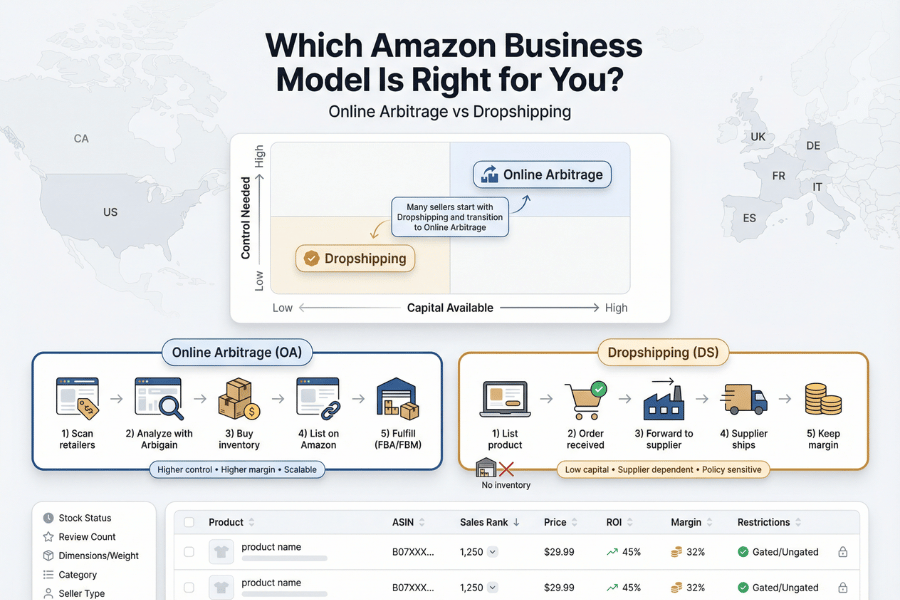
Online arbitrage and dropshipping are two of the most popular ways to start selling on Amazon without creating your own products. Both models allow sellers to leverage existing demand and Amazon’s global infrastructure, but they differ significantly in how products are sourced, analyzed, and fulfilled.
Understanding these differences is essential before choosing the model that aligns with your capital, time availability, and long-term growth strategy.
What Is Online Arbitrage?
Online arbitrage (OA) is the practice of purchasing products from online retailers at discounted prices and reselling them on Amazon at a higher price. The business relies on identifying pricing inefficiencies between marketplaces and acting on them quickly.
For example, a branded product may be discounted on a retail website while maintaining strong demand and higher pricing on Amazon. After accounting for fees, logistics, and taxes, the remaining spread becomes profit.
Modern online arbitrage is no longer based on guesswork. Successful sellers rely on data-driven platforms like Arbigain to evaluate demand, competition, historical pricing behavior, compliance risks, and real profit potential before committing capital.
How Online Arbitrage Works
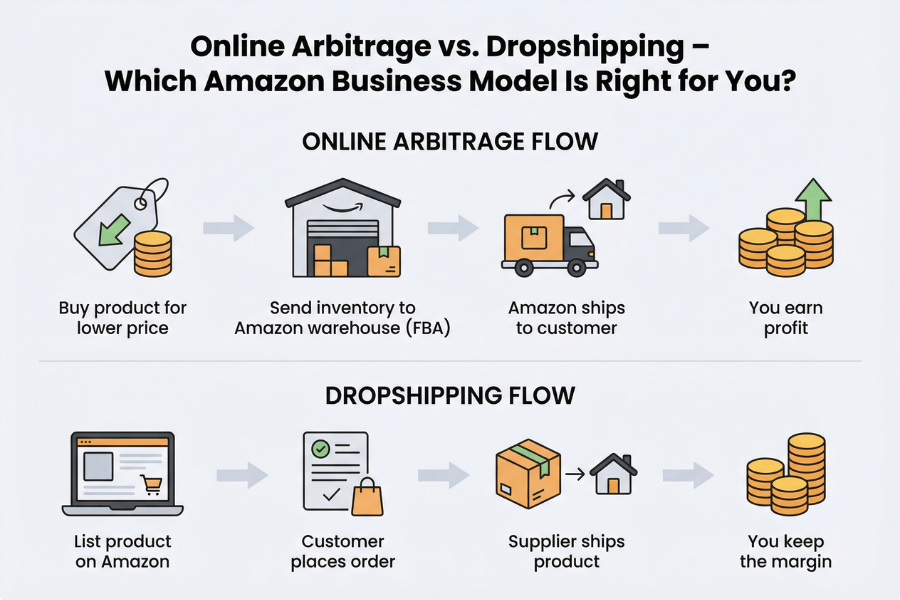
Online arbitrage follows a structured workflow:
First, the seller registers an Amazon Seller Central account and selects the appropriate selling plan.
Next, potential products are identified by scanning online retailers for pricing gaps.
Each product is then analyzed using Arbigain to assess sales velocity, competition intensity, category restrictions, and estimated margins.
Based on demand forecasts and budget limits, the seller decides how many units to purchase.
Products are listed on Amazon, usually by joining existing listings.
Orders are fulfilled either via Amazon fulfillment or merchant fulfillment.
Pricing is monitored dynamically to remain competitive.
Performance metrics and inventory turnover are tracked to support scaling.
The advantage of online arbitrage lies in control: sellers choose products, verify legitimacy, and manage fulfillment strategy.
What Is Dropshipping?
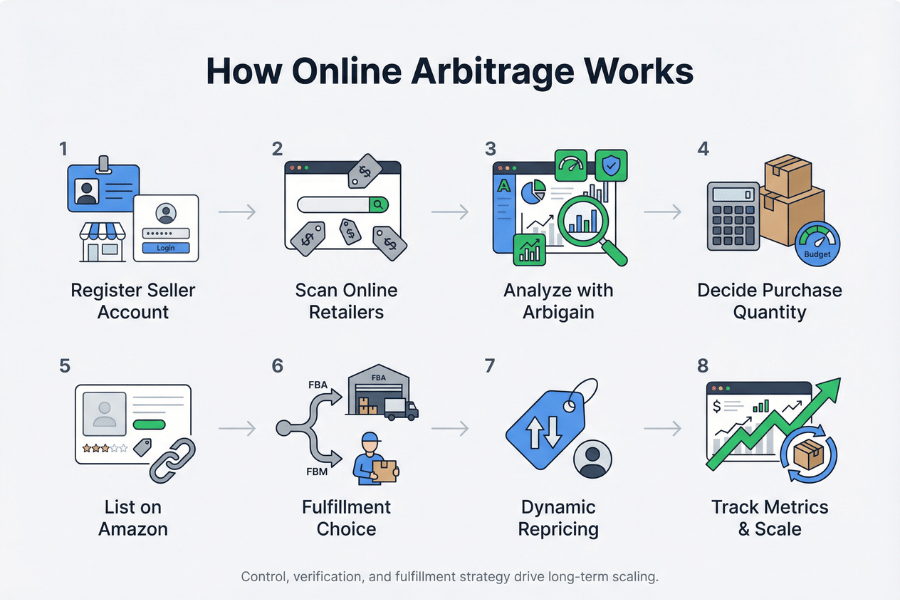
Dropshipping is a fulfillment model where the seller does not hold inventory. Products are listed on Amazon, and once an order is placed, the seller purchases the item from a third-party supplier who ships it on the seller’s behalf.
The seller’s profit is the difference between the Amazon selling price and the supplier’s cost, minus fees.
While dropshipping minimizes upfront investment, it introduces operational sensitivity. Supplier reliability, shipping speed, and strict adherence to Amazon policies become critical success factors.
How Amazon Dropshipping Works
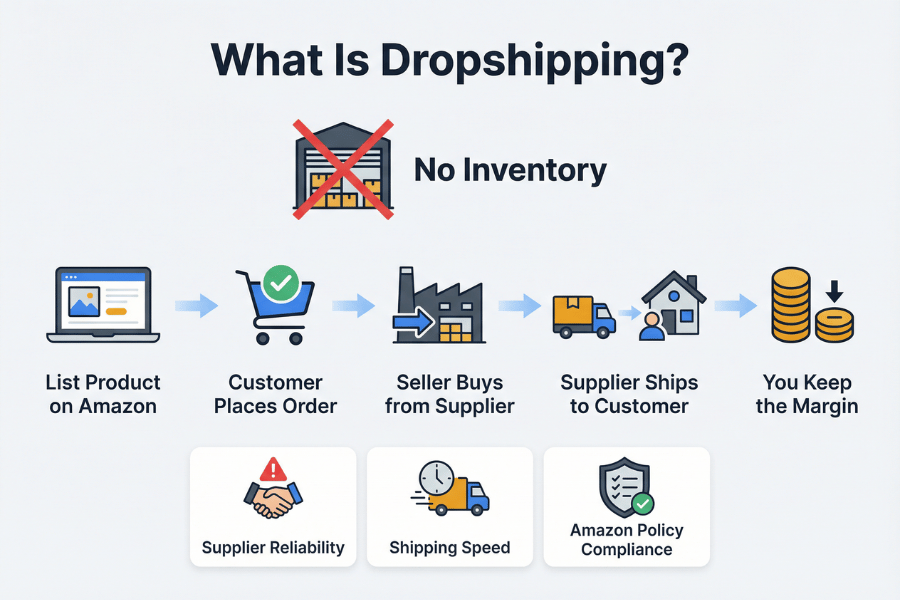
A compliant dropshipping workflow includes the following steps:
The seller opens an Amazon seller account.
Reliable suppliers are identified—ideally those capable of neutral or rebranded shipping.
Products are evaluated using Arbigain to confirm demand, profitability, and policy compliance.
Listings are created or matched on Amazon.
When an order is placed, details are forwarded to the supplier.
The product is shipped either directly to the customer or via a prep center for compliant packaging.
The seller retains the margin once the order is completed.
Using a data platform like Arbigain helps dropshippers avoid restricted brands, unstable pricing, and low-margin traps before listings go live.
Key Differences Between Online Arbitrage and Dropshipping
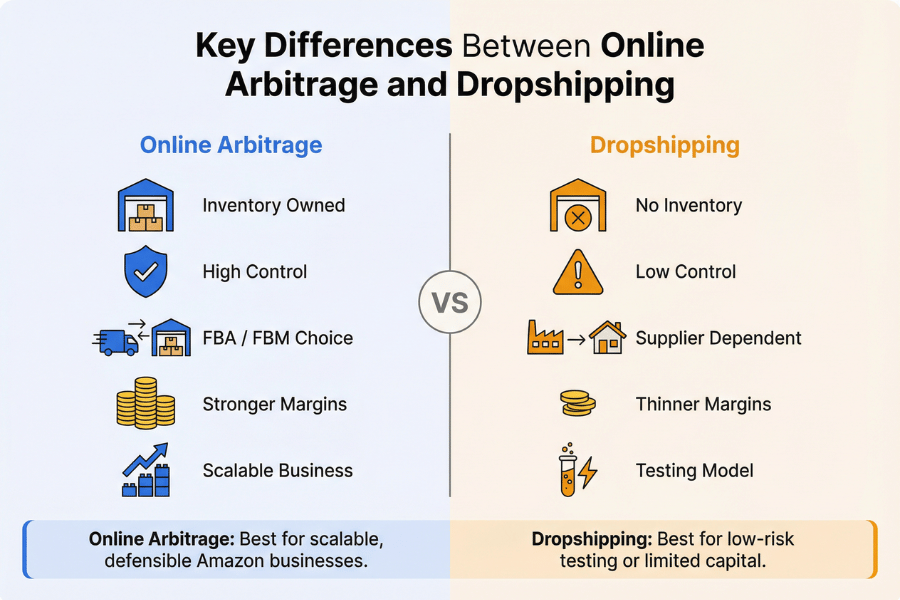
At a high level, both models allow sellers to operate without manufacturing products. The core difference lies in inventory ownership and operational control.
Online arbitrage requires purchasing inventory upfront, offering greater control over quality, fulfillment speed, and pricing strategy. Dropshipping eliminates inventory risk but reduces control and typically results in thinner margins.
Online arbitrage is better suited for sellers aiming to build a scalable, defensible business. Dropshipping works best as a low-risk testing model or for sellers with limited capital and time.
Pros and Cons of Online Arbitrage
Advantages
Online arbitrage is relatively easy to enter and does not require supplier negotiations.
Profit margins are generally higher due to pricing flexibility.
The model scales efficiently, especially when combined with fulfillment automation.
Data platforms like Arbigain significantly reduce sourcing time and decision risk.
Challenges
Product research can be time-intensive without proper tools.
Competition can be high on popular listings.
Brand and intellectual property restrictions require careful screening.
Pros and Cons of Dropshipping
Advantages
Low startup costs and minimal capital exposure.
No inventory holding or warehousing.
Easy to test multiple product ideas quickly.
Challenges
Limited control over product quality and delivery speed.
Lower profit margins compared to arbitrage.
High dependency on supplier reliability and policy compliance.
Choosing the Right Model for Your Amazon Business
The right model depends on your goals and constraints.
If you want a fast, low-cost entry into Amazon, dropshipping is a suitable starting point.
If you seek higher margins, stronger control, and long-term scalability, online arbitrage is the better choice.
If you prefer automation and reduced operational workload, online arbitrage paired with Amazon fulfillment is ideal.
If you want rapid market testing without handling inventory, dropshipping supported by Arbigain’s product validation tools is effective.
Many sellers start with dropshipping and transition into online arbitrage once they identify consistently profitable products.
Finding Profitable Products for Both Models
Regardless of the model, product selection is the decisive factor.
Profitable products typically demonstrate:
- Stable demand
- Moderate competition
- Predictable pricing behavior
- Sufficient margin after fees and taxes
- Low compliance and policy risk
Advanced sellers rely on Arbigain to consolidate sourcing, profitability analysis, restriction checks, and demand estimation into a single workflow—allowing faster decisions with lower risk.
Final Thoughts
Online arbitrage and dropshipping are both viable entry points into Amazon selling. Neither is inherently superior; success depends on execution quality and strategic alignment.
Online arbitrage rewards structure, capital discipline, and long-term thinking. Dropshipping rewards agility and low-risk experimentation.
By using a data-first platform like Arbigain, sellers can reduce uncertainty, avoid costly mistakes, and scale only what proves profitable. Treat Amazon as a real business from day one, and growth becomes a matter of optimization—not luck.